As high barriers to entry and a shortage of iconic locations push luxury developers to look beyond Phuket for top-end sites, ultra-luxury development is shifting north into Phang Nga’s oceanfront. The Khao Lak and Phang Nga Hotel & Tourism Market Review 2026 examines this shift across the province and its Khao Lak resort cluster. In Khao Lak, hotel performance trends are led by rate, with the average daily rate (ADR) up 26.2% year-on-year in the first quarter of 2026. Phang Nga tourism revenue reached THB56.6 billion (USD1.7 billion) in 2025 on 4.3 million visitor arrivals.
Key Sections Covered
- Khao Lak Hotel Performance Trends
- Phang Nga Tourism Demand, Visitor Arrivals and Tourism Revenue
- Phang Nga Southern Provinces Ranking
- Outlook and Phang Nga Hotel Pipeline
Investor Highlights
1. Khao Lak Hotel Performance Trends are Led by Rate, Not Volume
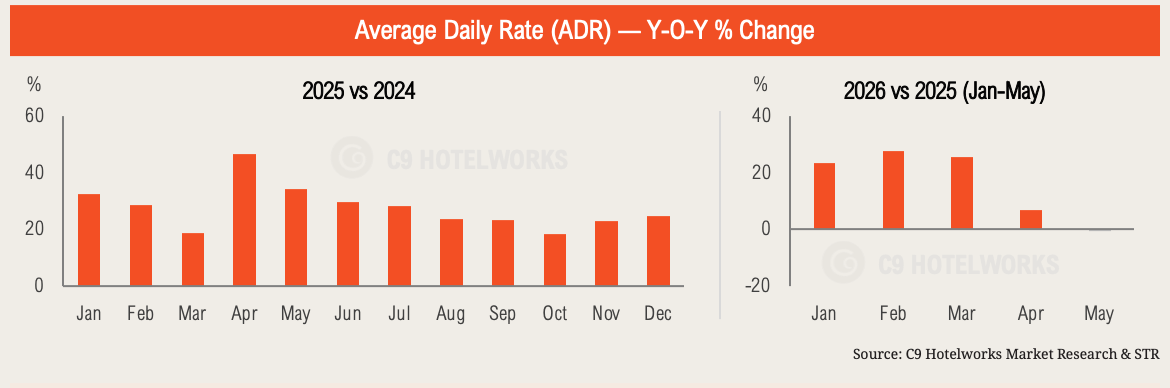
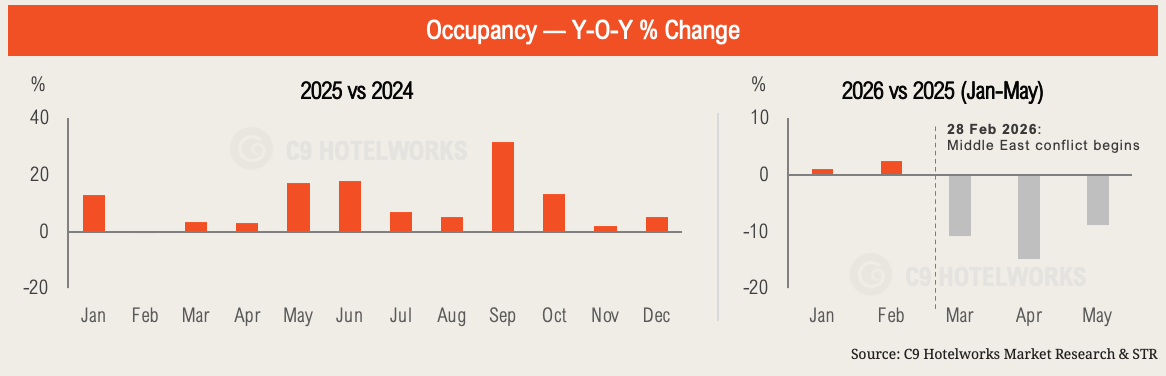
Average daily rate rose 26.2% year-on-year in the first quarter of 2026, extending 2025 gains, when monthly increases ranged from 18.2% to 46.4%. Occupancy, by contrast, turned negative year-on-year from March 2026, and revenue per available room (RevPAR) turned negative in April and May as the Middle East conflict and higher airfares softened international demand.
2. Visitor Arrivals Held Steady as the Wider Southern Region Contracted
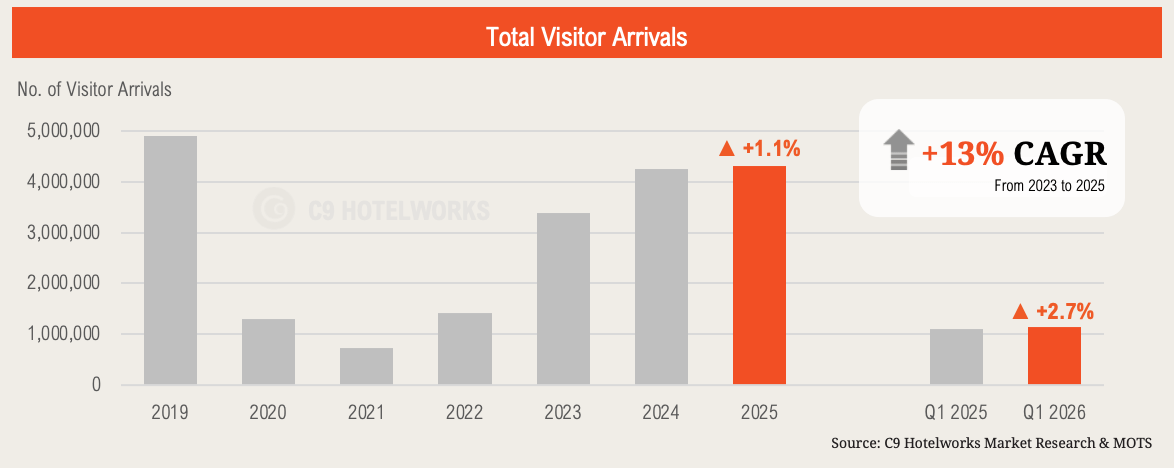
Phang Nga visitor arrivals reached 4.3 million in 2025, up 1.1% year-on-year and a 13% compound annual growth rate (CAGR) from 2023 to 2025, while Thailand’s Southern region (14 provinces) decreased by 0.6% over the same period. Tourism revenue rose 2% to THB56.6 billion (USD1.7 billion), ahead of the 1.1% increase in visitor arrivals.
The 2025 gain was domestic-led: international visitor arrivals held at 2.61 million, down 0.2%, while domestic visitor arrivals rose 3.2% to 1.7 million. Visitor arrivals rose a further 2.7% year-on-year in the first quarter of 2026, before international demand softened from March.
3. Phang Nga Ranks Fourth by Revenue but Sixth by Visitor Volume
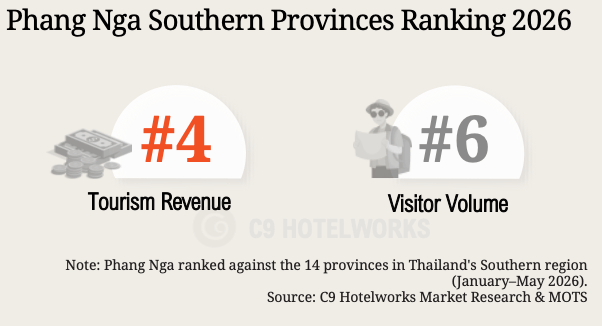
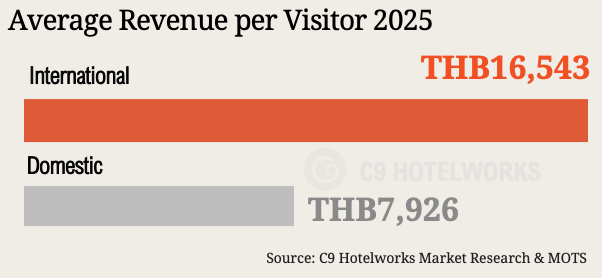
As of May 2026, Phang Nga ranked fourth of the 14 provinces in Thailand’s Southern region by tourism revenue, behind Phuket, Surat Thani and Krabi, but sixth by visitor volume, a sign of higher spending per visitor. In 2025, international visitors made up 61% of visitor arrivals but 76% of revenue, spending more than double per head (THB16,543) than domestic visitors (THB7,926). With 2025 growth outpacing a contracting region, this top-end positioning continues to draw luxury developers north from Phuket into Phang Nga.
4. The Outlook Points to Top-End Development Shifting North from Phuket into Phang Nga
As high barriers to entry and a shortage of iconic locations push luxury developers to look beyond Phuket for top-end sites, ultra-luxury development is shifting into Phang Nga Bay and the coastline north of the Sarasin Bridge, from Natai to Thai Muang, where oceanfront sites support full-service resorts rather than commoditized, box-type product. The active pipeline consists of 315 keys, led by the InterContinental Phang-Nga Bay Resort (150 keys, 2028) and Kimpton Natai (150 keys, 2027), alongside a 15-key expansion of Khaolak Paradise Resort in 2026.
Meanwhile, Khao Lak is maturing as a market, helped by four-lane access from Phuket International Airport and the 170-hectare Matalay integrated resort community, featuring five international-standard resort sites.
Phuket is entering its next growth cycle, supported by infrastructure expansion and regulatory reforms. Planned airport upgrades and new transport infrastructure are expected to alleviate capacity constraints and improve island-wide connectivity. Concurrently, stricter enforcement of unlicensed accommodations, revised building height regulations, and new zoning frameworks are formalizing the market and enabling more efficient, higher-density developments. Together, these factors position Phuket to transition toward a more structured real estate market.

Tourism Overview
Despite a decline in Chinese arrivals, Phuket welcomed 8.8 million passenger arrivals in 2025, supported by growth across diversified source markets. Looking ahead, Chinese tourism is expected to gradually recover alongside continued expansion from emerging markets such as India, South Korea, and Israel.
Ongoing geopolitical tensions have positioned Thailand as a safe and neutral destination, while strengthening its role as a regional transit hub connecting Australia and New Zealand with Europe and other global markets. This shift is expected to support additional passenger arrivals and increased transit traffic through the country.

Hotel Market Performance
ADR rose 5% despite a 6% decline in occupancy. As additional hotel supply enters the market and regional competition intensifies, ADR growth is expected to moderate toward more sustainable levels.
Phuket’s tourism landscape is highly segmented, with distinct locations catering to different demand profiles and positioning.
- Luxury Markets: Surin commands the highest ADR and lowest occupancy rate in Phuket, with 21% growth in ADR but 9% drop in occupancy. Mai Khao ranks second in ADR, both driven by luxury resorts and its secluded beachfront setting.
- Integrated and Upscale Resorts: Bangtao recorded a 2% decline in occupancy rate while achieving a 20% increase in ADR. Meanwhile, Kamala, known for its upscale family-oriented resorts, continues to command 40% higher ADR than Bangtao despite slower growth and 24% decrease in occupancy rate.
- Mass & Tourism Clusters: Patong, a tourism hotspot for budget travelers, records the highest occupancy in Phuket despite an 8% decline this year. Karon and Phuket Old Town cater to similar demand segments with economy and midscale accommodations.

Hotel Pipeline
Phuket’s hotel pipeline from 2026 to 2030 includes 41 projects, with total market supply expected to surpass 100,000 keys by 2026. Bangtao/Cherngtalay continues to lead future supply, accounting for approximately 30% of the pipeline, with a high concentration in the upper-upscale segment.

Future Outlook
Beyond airport expansion to accommodate growing tourism demand, zoning reforms and integrated developments are reshaping key areas such as Bangtao into more structured urban clusters, reflecting Phuket’s evolution from a resort-driven island into a more institutionalized tourism market.

Key Sections Covered in the Report
- Phuket Airport Expansion
- Tourism Overview
- Hotel Market Performance
- Hotel Pipeline
- Future Outlook
#PhuketHotelMarket #PhuketTourism #PhuketHospitality #ThailandTourism #ThailandHotelsMarket #C9Hotelworks
C9 Hotelworks and Watson Farley & Williams present the Thailand Hotel Investment Guide 2026, providing a comprehensive review of tourism demand dynamics, hotel performance trends, key destination insights, infrastructure catalysts, the hotel investment lending landscape, sustainability implications, and legal considerations shaping Thailand’s hospitality investment environment.
Investor Highlights
1. Thailand Remains a Diversified Tourism Market
Thailand recorded approximately 33.0 million international arrivals in 2025, with total tourism revenue reaching THB 2.9 trillion. While Chinese arrivals remain below historical levels, demand diversification across Malaysia, India, Russia, the UK, and the US has strengthened resilience. According to the Tourism Authority of Thailand (TAT), international arrivals are projected at approximately 35 million in 2026, reflecting continued government-led tourism initiatives and sustained destination confidence.

2. Hotel Performance Dispersion and Emerging Markets
Hotel performance in 2025 displayed increasing dispersion across Thai markets, reflecting differences in demand composition, airlift exposure, and domestic reliance. At the regional level, the South recorded marginal occupancy growth of 0.3% year-on-year, while ADR increased by 20.4%, indicating strong rate expansion in resort-driven markets (e.g., Phuket, Samui, Krabi). In contrast, the Central and North regions experienced a 4.6% decline in occupancy, while ADR grew by 5.6%.

Emerging destinations, including Koh Samui and Phang Nga, recorded simultaneous growth in visitor arrivals and hotel performance indicators. The forward trajectory of these markets remains closely tied to infrastructure delivery, notably the proposed Koh Samui Expressway Project and the planned Andaman International Airport in Khok Kloi, Phang Nga. If executed, these projects would materially expand international accessibility and reshape long-term demand capacity in the Andaman corridor.

3. Hotel Lending Landscape and Legal Framework
Thailand’s hotel lending environment remains active but disciplined. Lenders continue to emphasize developer track record, location quality, cash flow stability, sponsor strength, and conservative capital structures, with minimum DSCR thresholds typically at 1.2x for development and 1.4–1.5x for stabilized assets. Loan-to-value (LTV) ratios generally range between 50–60%, reflecting heightened underwriting discipline. Sustainability credentials are increasingly influencing underwriting standards, while institutional liquidity remains focused on prime and well-positioned assets.
From a legal perspective, Thailand offers a structured framework for hotel investment, including:
- Board of Investment (BOI) incentives for eligible projects
- Foreign Business License (FBL) considerations
- Defined land tenure structures
- Clear regulatory processes for Hotel Business License and EIA compliance
- Established transaction structuring options (asset vs. share deals)
For foreign investors, BOI eligibility and ownership structuring remain critical determinants of project feasibility, financing access, and exit liquidity.
Sustainability considerations are increasingly embedded within underwriting standards and institutional capital mandates. ESG alignment now functions as a risk-adjustment factor influencing financing access, margin pricing, and long-term liquidity.
Key Sections Covered in the Report
- Thailand Tourism Overview
- Performance Comparison Across Key Markets (2025 vs 2024)
- Structural Cost Realignment and Margin Discipline
- Forward Outlook (2026–2030)
- Hotel Investment Insights: Lending Landscape
- Sustainability as a Capital Market Lever
- Legal and Foreign Ownership Framework
#ThailandHotelInvestment #HotelInvestmentGuide #ThailandTourism #HospitalityInvestment #HotelMarketThailand #TourismTrends #HotelPerformance #InvestmentInsights #HospitalityReport #HotelIndustry #C9Hotelworks #C9Insider
Eastern Thailand plays a significant role in Thailand’s tourism economy. The region benefits from its coastal and island destinations, close proximity to Bangkok, surrounding industrial zones, and its position as a key domestic and cross-border travel corridor. The region covered in this report includes Chanthaburi, Chachoengsao, Chonburi, Trat, Nakhon Nayok, Prachinburi, Rayong, and Sa Kaeo.
VISITOR ARRIVALS VOLUME IN EASTERN THAILAND


From January to November 2025, the region welcomed 47.7 million visitors, representing 14.8% of Thailand’s total 323 million arrivals (international and domestic combined). These visits generated approximately THB374 billion in tourism revenue, or around 14.5% of national tourism receipts.
Domestic tourism provided the main support throughout the year. Domestic arrivals rose 5.5% year-on-year to 36.9 million, driven by short-haul leisure trips and seasonal travel patterns. In contrast, international arrivals declined 11.2% year-on-year to 10.8 million, outpacing the national decline of 5.9%, reflecting softer external economic conditions in the second half of the year.
Despite steady domestic volumes, overall tourism revenue in Eastern Thailand decreased by 2.3% year-on-year, from THB391 billion in 2024 to THB374 billion in 2025. This was largely due to the lower average spending of domestic travelers (THB7,845 per person) compared with international visitors (THB18,675 per person).
Looking ahead, the regional tourism market is expected to gradually strengthen in 2026 as international travel confidence improves. Domestic and short-haul independent travel, particularly the “drive-in” segment, continues to demonstrate resilience and is supporting economic activity across the region. Additional growth momentum is anticipated from visa-free travel arrangements, airport expansion, smart-tourism initiatives, and the continued shift toward experience-led travel, collectively positioning Eastern Thailand for steady, broad-based recovery and expansion.
Asia Branded residences’ market value climbs to a historic high of USD30.7 Billion, with Thailand leading by market share, followed by the Philippines, South Korea, Japan, and Malaysia. Vietnam is forecasted to lead Asia with one in four branded residence units, recorded as the region’s largest pipeline.
BRANDED RESIDENCES IN ASIA BY MARKET VALUE AND RESIDENCES PIPELINE 2025

The active pipeline of branded residences in Asia available for sale is valued at USD30.7 billion, comprising 38,893 units across 178 projects. Thailand holds 18% of the market share, leading the region, followed by the Philippines with 12% and South Korea at 11%. There are an additional 28,460 units across 105 projects of future supply that have yet to be released for sale, with Vietnam accounting for 41% of this total.
Over the past five years (2021-2025), the market has expanded at a compound annual growth rate of 10%. The majority of the active pipeline comprises co-located branded residences with a hotel, accounting for 57% of the supply. However, mixed-use developments and standalone branded residences are gaining traction, representing 24% and 19%, respectively. Geographically, the active pipeline is concentrated in urban destinations, which account for 53% of the market, with key cities including Bangkok, Kuala Lumpur, Manila, Mumbai, and Davao. Resort destinations such as Phuket, Pattaya, Da Nang, Cebu, and Hoi An comprise the remaining 47%.
Samui tourism market strengthened by 9% growth in air arrivals and 6% rise in cruise visitors. Samui hotel industry recorded an 8% year-on-year increase in the occupancy rate, while the ADR rose by up to 21% in April. From January to April 2025, Samui International Airport welcomed 1,127,832 passenger arrivals. For the full year 2024, total arrivals reached 2,781,564, representing a 21% year-on-year growth and exceeding the 2019 prepandemic level of 2,417,246. These figures underscore the island’s strong recovery.
SAMUI HOTEL AND TOURISM PERFORMANCE


European travelers accounted for 56% of international arrivals in 2024, led by Germany, the United Kingdom, and France. The European market saw double-digit growth over the previous year, supported by enhanced air connectivity through Bangkok Airways and 30 codeshare partners with international carriers across Europe and Australia, including Lufthansa, Air France, and KLM. China ranked as the leading Asian source market in 2024, driven by non-scheduled direct flights connecting Samui with Chengdu and Chongqing via Bangkok Airways, and Xi’an via Tibet Airlines.
Currently, scheduled international flights to Samui remain limited, with Bangkok Airways operating direct services from Singapore and Hong Kong. These flights represented 14% of total flights from January to April 2025, compared to 22% during the same period in 2019.
Samui’s cruise tourism sector has also shown strong performance. The island ranked among the top three busiest cruise ports in Thailand, alongside Patong Bay in Phuket and Laem Chabang in Chonburi. In 2024, Samui received 50 cruise liners with a total of 94,681 passengers, nearly doubling the 32 vessels and 51,227 passengers recorded in 2023. The top five cruise source markets in 2024 were Germany, the United States, the United Kingdom, Canada, and Australia. From January to April 2025, the island welcomed 35 cruise ships carrying 65,792 passengers, reflecting a 6% year-on-year increase.
#SamuiHotelandTourism #SamuiHotelReport #SamuiTourismReport #SamuiLuxuryHotels #SamuiHotelInvestment #SamuiHotelInvestmentGuide #SamuiHotelMarket2025 #SamuiTourismStatistics #SamuiHotelOccupancyRate #Samuicruisetourismgrowth #SamuihotelADRgrowth2025 #Samuihotelinvestmentopportunities #CruiseTourismSamui #C9Hotelworks#C9Insider
The Ministry of Tourism and Sports has shown the European long-haul market lifts Phang Nga occupancy to 79%, up to 8% year-on-year. Khao Lak hotel market also demonstrated RevPAR surged 30% in 2024 compared to pre-pandemic 2019 levels. In 2024, Phang Nga welcomed a total of 4,142,571 guest arrivals at accommodation establishments, reflecting a strong recovery with a 23% year-on-year increase from 2023. This positive momentum continued into the first quarter of 2025, with 1,105,454 guest arrivals, an increase of 9% compared to the same period in the previous year. These trends highlight the province’s sustained growth in tourism demand.
PHANG NGA’S HOTEL MARKET STATISTICS 2024

KHAO LAK’S HOTEL MARKET PERFORMANCE 2024

European travelers accounted for 78% of total international guest arrivals in 2024, reaffirming Phang Nga’s position as a key long-haul leisure destination. Additional contributions from Asia at 8%, Oceania at 7%, and the Middle East at 7% highlight an increasingly diverse international visitor base. The strong performance has been supported by increased international flight capacity during the winter season, Thailand’s visa exemption policy for 93 countries, and improved air connectivity, all of which have contributed to the continued growth in tourism.
Khao Lak’s hotel market demonstrated solid performance in the first quarter of 2025, with the average daily rate increasing by 7% compared to the same period in 2024. Revenue per available room also rose by 6% year-on-year, indicating continued strength in both rate levels and room night demand.
In the real estate sector, Phang Nga experienced continued appreciation in land values, driven by the expansion of luxury resorts and upscale residential villa developments. The upward trend has been further supported by infrastructure improvements, including enhanced road connectivity from Phuket, the planned Andaman International Airport in Khok Kloi, and the Maritime Hub Project. These developments are expected to improve accessibility and reinforce the province’s attractiveness to both investors and developers seeking long-term opportunities in the tourism and residential sectors.
#KhaoLakHotelandTourismMarket #PhangNgaHotelandTourismMarket #SouthernThailandHotelMarket #ThailandHotelMarket #ThailandTourismMarket #ThailandMarketUpdate #C9Hotelworks #C9Insider #KhaoLakPhangNgaHotelMarketReport #SouthernThailandTourism
Over the past two decades, Lombok’s real estate landscape has evolved significantly, propelled by the island’s expanding tourism and hospitality sectors. The initial wave of development began when foreign investors acquired greenfield sites and subdivided them into serviced land plots, marketed as ready-to build parcels within master-planned estates. These offerings primarily attracted speculative land investors and individual buyers looking to construct holiday villas at significantly lower costs compared to more established destinations such as South Bali. This phase laid the groundwork for Lombok’s emerging residential market.
LOMBOK’S HOSPITALITY-MANAGED REAL ESTATE MARKET SUPPLY 2025

A major turning point came in 2011 with the opening of Lombok International Airport in Central Lombok, replacing the former Selaparang Airport in Mataram. Enhanced air connectivity spurred a new phase of tourism growth, leading to the rise of standalone short-term rental villas and hospitality-managed residences such as Selong Selo and BASK Gili Meno.These hospitality-managed residences, typically characterized by unobstructed panoramic ocean views or prime beachfront locations, concentrated in key areas, including the Gili Islands, Senggigi, and Selong Belanak.
In recent years, growing interest from international investors—particularly from Singapore, Hong Kong, Europe, and Australia—has driven a surge in land values, with increases ranging from 50% to 200% in parts of South Lombok. As land prices escalated, the market began shifting from standalone serviced land plots to integrated hospitality-led residential communities and off-plan villa developments. To date, Lombok’s hospitality-managed real estate market comprises 1,326 units across 18 developments, along with 798 independent holiday rental villas. These two segments now define Lombok’s hospitality-managed real estate sector.
#LombokBrandedResidences #IndonesiaHotelandTourismMarket #LombokLuxuryCondominiums #LombokResidences #LombokVillaCondominiumMarket #LombokMarket2025 #LombokResidentialInvestmentMarket #C9Hotelworks #C9Insider
Bali’s hospitality-managed real estate market has evolved significantly over the past few decades, transitioning from small-scale independent developments to a key hub for internationally branded residences. This year, Bali branded residences market continues to attract new entrants including Mandarin Oriental, Anantara, and Aman (Amankila).
BALI’S BRANDED RESIDENCES MARKET UPDATE 2025

Branded residences first emerged in Bali in the 1990s, with Aman (Aman Villas at Nusa Dua) establishing a foothold. The early 2000s saw further growth, with Banyan Tree, Bvlgari, and Karma launching developments, particularly in Nusa Dua, Bukit Peninsula, and Jimbaran. While branded residences account for 15% of the total supply, they remain a niche segment compared to non-branded developments. However, investor interest is rising as buyers prioritize structured, professionally managed properties, particularly in an environment of tightening regulatory oversight and increasing demand for credible, brand-backed investments.